Elasticipy.SphericalFunction module
- class Elasticipy.SphericalFunction.HyperSphericalFunction(fun)[source]
Bases:
SphericalFunctionClass for defining functions that depend on two orthogonal directions u and v.
- domain = array([[0. , 6.28318531], [0. , 1.57079633], [0. , 3.14159265]])
- eval(u, *args)[source]
Evaluate the Hyperspherical function with respect to two orthogonal directions.
- Parameters:
u (list or np.ndarray) – First axis
args (list or np.ndarray) – Second axis
- Returns:
Function value
- Return type:
float or np.ndarray
See also
eval_sphericalevaluate the function along a direction defined by its spherical coordinates.
- eval_spherical(*args, degrees=False)[source]
Evaluate value along a given (set of) direction(s) defined by its (their) spherical coordinates.
- Parameters:
args (list or np.ndarray) –
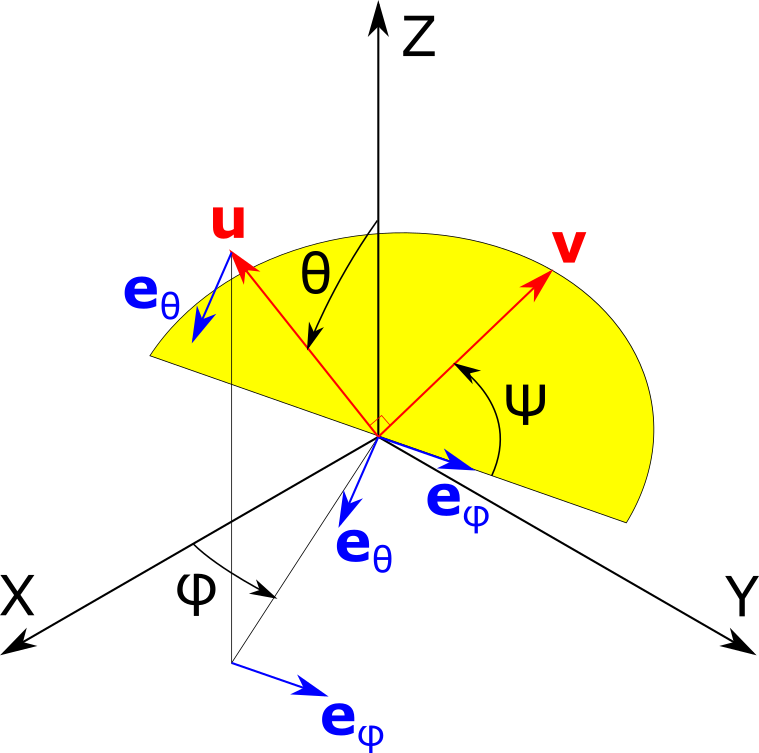
[phi, theta, psi] where phi denotes the azimuth angle from X axis to the first direction (u), theta is the latitude angle from Z axis (theta==0 -> u = Z axis), and psi is the angle defining the orientation of the second direction (v) in the plane orthogonal to u, as illustrated below:
- degreesbool, default False
If True, the angles are given in degrees instead of radians.
- Returns:
float or np.ndarray – If only one direction is given as a tuple of floats [nx, ny, nz], the result is a float;
otherwise, the result is a nd.array.
See also
evalevaluate the function along two orthogonal directions (u,v))
- mean(method='Monte Carlo', n_evals=10000, seed=None)[source]
Estimate the mean value along all directions in the 3D space.
- Parameters:
method (str {'exact', 'Monte Carlo'}) – If ‘exact’, the full integration is performed over the unit sphere (see Notes). If method==’Monte Carlo’, the function is evaluated along a finite set of random directions. The Monte Carlo method is usually very fast, compared to the exact method.
n_evals (int, default 10000) – If method==’Monte Carlo’, sets the number of random directions to use.
seed (int, default None) – Sets the seed for random sampling when using the Monte Carlo method. Useful when one wants to reproduce results.
- Returns:
Mean value
- Return type:
float
See also
stdStandard deviation of the spherical function over the unit sphere.
Notes
The full integration over the unit sphere, used if method==’exact’, takes advantage of numpy.integrate.dblquad. This algorithm is robust but usually slow. The Monte Carlo method can be 1000 times faster.
- name = 'Hyperspherical function'
Bounds to consider in spherical coordinates
- plot3D(n_phi=50, n_theta=50, n_psi=50, which='mean', **kwargs)[source]
3D plotting of a spherical function
- Parameters:
n_phi (int, default 50) – Number of azimuth angles (phi) to use for plotting. Default is 50.
n_theta (int, default 50) – Number of latitude angles (theta) to use for plotting. Default is 50.
n_psi (int, default 50) – Number of psi value to look for min/max/mean value (see below). Default is 50.
which (str {'mean', 'std', 'min', 'max'}, default 'mean') – How to handle the 3rd coordinate. For instance, if which==’mean’ (default), for a given value of angles (phi, theta), the mean function value over all psi angles is plotted.
**kwargs – These arguments will be passed to ax.plot_surface() function.
- Returns:
matplotlib.figure.Figure – Handle to the figure
matplotlib.Axes3D – Handle to axes
See also
plot_xyz_sectionsplot statistics in X-Y, X-Z and Y-Z planes
- plot_xyz_sections(n_theta=500, n_psi=100)[source]
Plot statistics in X-Y, X-Z and Y-Z planes.
The function value will be plotted as functions of the first direction (u), whereas the second direction (v) will be used to evaluate the statistics (min/max and mean).
- Parameters:
n_theta (int, default 500) – Number of values of polar angle to use for plotting
n_psi (int, default 100) – Number of psi value to use for evaluating the statistics (mean, min and max)
- Returns:
matplotlib.figure.Figure – Handle to the figure
matplotlib.Axes3D – Handle to axes
See also
plot3Dplot a given statistic as a 3D surface
- var(method='Monte Carlo', n_evals=10000, mean=None, seed=None)[source]
Estimate the variance along all directions in the 3D space
- Parameters:
method (str {'exact', 'Monte Carlo'}) – If ‘exact’, the full integration is performed over the unit sphere (see Notes). If method==’Monte Carlo’, the function is evaluated along a finite set of random directions. The Monte Carlo method is usually very fast, compared to the exact method.
n_evals (int, default 10000) – If method==’Monte Carlo’, sets the number of random directions to use.
mean (float, default None) – If provided, and if method==’exact’, skip estimation of mean value and use that provided instead.
seed (int, default None) – Sets the seed for random sampling when using the Monte Carlo method. Useful when one wants to reproduce results.
- Returns:
Variance of the function
- Return type:
float
See also
meanmean value of the function over the unit sphere.
Notes
The full integration over the unit sphere, used if method==’exact’, takes advantage of numpy.integrate.dblquad. This algorithm is robust but usually slow. The Monte Carlo method can be 1000 times faster.
- class Elasticipy.SphericalFunction.SphericalFunction(fun)[source]
Bases:
objectClass for spherical functions, that is, functions that depend on directions in 3D space.
Attribute
fun : function to use
- domain = array([[0. , 6.28318531], [0. , 1.57079633]])
- eval(u)[source]
Evaluate value along a given (set of) direction(s).
- Parameters:
u (np.ndarray or list) – Direction(s) to estimate the value along with. It can be of a unique direction [nx, ny, nz], or a set of directions (e.g. [[n1x, n1y n1z],[n2x, n2y, n2z],…]).
- Returns:
If only one direction is given as a tuple of floats [nx, ny, nz], the result is a float; otherwise, the result is a nd.array.
- Return type:
float or np.ndarray
See also
eval_sphericalevaluate the function along a given direction given using the spherical coordinates
- eval_spherical(*args, degrees=False)[source]
Evaluate value along a given (set of) direction(s) defined by its (their) spherical coordinates.
- Parameters:
args (list or np.ndarray) – [phi, theta] where phi denotes the azimuth angle from X axis, and theta is the latitude angle from Z axis (theta==0 -> Z axis).
degrees (bool, default False) – If True, the angles are given in degrees instead of radians.
- Returns:
If only one direction is given as a tuple of floats [phi, theta], the result is a float; otherwise, the result is a nd.array.
- Return type:
float or np.ndarray
See also
evalevaluate the function along a direction given by its cartesian coordinates
- max()[source]
Find maximum value of the function.
- Returns:
min (float) – Maximum value
direction (np.ndarray) – direction along which the maximum value is reached
See also
minreturn the minimum value and the location where it is reached
- mean(method='exact', n_evals=10000, seed=None)[source]
Estimate the mean value along all directions in the 3D space.
- Parameters:
method (str {'exact', 'Monte Carlo'}) – If ‘exact’, the full integration is performed over the unit sphere (see Notes). If method==’Monte Carlo’, the function is evaluated along a finite set of random directions. The Monte Carlo method is usually very fast, compared to the exact method.
n_evals (int, default 10000) – If method==’Monte Carlo’, sets the number of random directions to use.
seed (int, default None) – Sets the seed for random sampling when using the Monte Carlo method. Useful when one wants to reproduce results.
- Returns:
Mean value
- Return type:
float
See also
stdStandard deviation of the spherical function over the unit sphere.
Notes
The full integration over the unit sphere, used if method==’exact’, takes advantage of numpy.integrate.dblquad. This algorithm is robust but usually slow. The Monte Carlo method can be 1000 times faster.
- min()[source]
Find minimum value of the function.
- Returns:
fmin (float) – Minimum value
dir (np.ndarray) – Direction along which the minimum value is reached
See also
maxreturn the maximum value and the location where it is reached
- name = 'Spherical function'
Bounds to consider in spherical coordinates
- plot3D(n_phi=50, n_theta=50, **kwargs)[source]
3D plotting of a spherical function
- Parameters:
n_phi (int, default 50) – Number of azimuth angles (phi) to use for plotting. Default is 50.
n_theta (int, default 50) – Number of latitude angles (theta) to use for plotting. Default is 50.
**kwargs – These parameters will be passed to matplotlib plot_surface() function.
- Returns:
matplotlib.figure.Figure – Handle to the figure
matplotlib.Axes3D – Handle to axes
See also
plot_xyz_sectionsplot values of the function in X-Y, X-Z an Y-Z planes.
- plot_xyz_sections(n_theta=500)[source]
Plot values in X-Y, X-Z and Y-Z planes
- Parameters:
n_theta (int, default 500) – Number of values of polar angle to use for plotting
- Returns:
matplotlib.figure.Figure – Handle to the figure
matplotlib.Axes3D – Handle to axes
See also
plot3Dplot the values of the function over the whole unit sphere as a 3D surface
- std(**kwargs)[source]
Standard deviation of the function along all directions in the 3D space.
- Parameters:
**kwargs – These parameters will be passed to var() function
- Returns:
Standard deviation
- Return type:
float
See also
varvariance of the function
- var(method='exact', n_evals=10000, mean=None, seed=None)[source]
Estimate the variance along all directions in the 3D space
- Parameters:
method (str {'exact', 'Monte Carlo'}) – If ‘exact’, the full integration is performed over the unit sphere (see Notes). If method==’Monte Carlo’, the function is evaluated along a finite set of random directions. The Monte Carlo method is usually very fast, compared to the exact method.
n_evals (int, default 10000) – If method==’Monte Carlo’, sets the number of random directions to use.
mean (float, default None) – If provided, and if method==’exact’, skip estimation of mean value and use that provided instead.
seed (int, default None) – Sets the seed for random sampling when using the Monte Carlo method. Useful when one wants to reproduce results.
- Returns:
Variance of the function
- Return type:
float
See also
meanmean value of the function over the unit sphere.
Notes
The full integration over the unit sphere, used if method==’exact’, takes advantage of numpy.integrate.dblquad. This algorithm is robust but usually slow. The Monte Carlo method can be 1000 times faster.
- Elasticipy.SphericalFunction.sph2cart(*args)[source]
Converts spherical/hyperspherical coordinates to cartesian coordinates.
- Parameters:
args (tuple) – (phi, theta) angles for spherical coordinates of direction u, where phi denotes the azimuth from X and theta is the colatitude angle from Z. If a third argument is passed, it defines the third angle in hyperspherical coordinate system, that is the orientation of the second vector v, orthogonal to u.
- Returns:
np.ndarray – directions u expressed in cartesian coordinates system.
tuple of (np.ndarray, np.ndarray) – direction of the second vector, orthogonal to u, expressed in cartesian coordinates system.
- Elasticipy.SphericalFunction.uniform_spherical_distribution(n_evals, seed=None, return_orthogonal=False)[source]
Create a set of vectors whose projections over the unit sphere are uniformly distributed.
- Parameters:
n_evals (int) – Number of vectors to generate
seed (int, default None) – Sets the seed for the random values. Useful if one wants to ensure reproducibility.
return_orthogonal (bool, default False) – If true, also return a second set of vectors which are orthogonal to the first one.
- Returns:
u (np.ndarray) – Random set of vectors whose projections over the unit sphere are uniform.
v (np.ndarray) – Set of vectors with the same properties as u, but orthogonal to u. Returned only if return_orthogonal is True
Notes
- The returned vector(s) are not unit. If needed, one can use:
u = (u.T / np.linalg.norm(u, axis=1)).T