Note
Go to the end to download the full example code.
Average stiffness of fibre texture
This example shows how to compute the Voigt-Reuss-Hill average of crystals with perfect fibre texture.
Define fibre texture
We define the stiffness tensor for BCC austenite using its elastic constants. They are taken from the Materials Project (mp-13).
from elasticipy.tensors.elasticity import StiffnessTensor
C = StiffnessTensor.cubic(C11=274, C12=175, C44=89)
Create a gamma fibre texture
The gamma texture correspond to alignment of <1 1 1> with normal direction.
from elasticipy.crystal_texture import FibreTexture
gamma = FibreTexture.gamma()
print(gamma)
Fibre texture
<1. 1. 1.> || [0, 0, 1]
Plot the corresponding pole figure
The pole figure of uvw directions, defined with the help of orix, as pole figures. Eg.:
fig, ax = gamma.plot_as_pole_figure(uvw=[1,0,0])
Compute the Hill average
The Voigt-Reuss-Hill average of the polycrystal is:
Chill = C.Hill_average(orientations=gamma)
print(Chill)
Stiffness tensor (in Kelvin mapping):
[[310.73 164.6  148.67   0.     0.     0.  ]
 [164.6  310.73 148.67  -0.    -0.    -0.  ]
 [148.67 148.67 326.67  -0.     0.     0.  ]
 [  0.    -0.     0.   120.76   0.    -0.  ]
 [  0.    -0.    -0.    -0.   120.76   0.  ]
 [ -0.     0.    -0.    -0.     0.   146.13]]
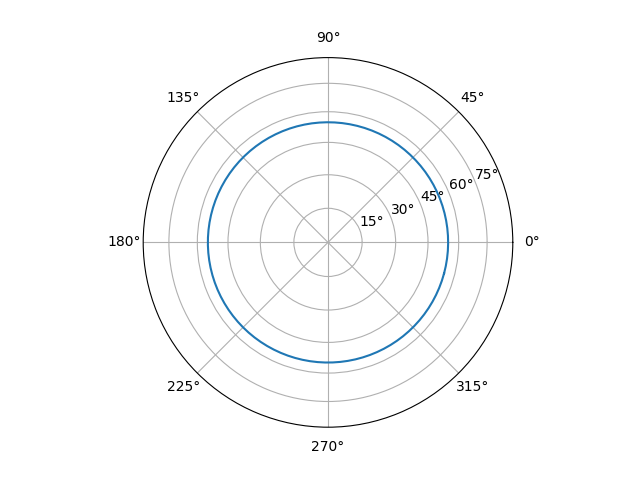
Check transversely isotropy
The transversely isotropy, resulting from the fibre texture along ND, can be evidenced by looking at the Young modulus, which is constant along any direction in XY plane:
Total running time of the script: (0 minutes 0.403 seconds)