Note
Go to the end to download the full example code.
Compute and plot wave velocities
This example shows how to compute the wave velocities from the stiffness tensor, and how to plot them
Define the stiffness tensor for forsterite
We define the stiffness tensor for a forsterite (taken from the similar tutorial for MTEX users.) as well as the mass density
from elasticipy.tensors.elasticity import StiffnessTensor
C = StiffnessTensor.orthorhombic(phase_name='forsterite',
                                 C11=320, C12=68.2, C13=71.6, C22=196.5, C23=76.8,
                                 C33=233.5, C44=64, C55=77, C66=78.7)
rho = 3.36 # kg/dm³!
print(C)
Stiffness tensor (in Voigt mapping):
[[320.   68.2  71.6   0.    0.    0. ]
 [ 68.2 196.5  76.8   0.    0.    0. ]
 [ 71.6  76.8 233.5   0.    0.    0. ]
 [  0.    0.    0.   64.    0.    0. ]
 [  0.    0.    0.    0.   77.    0. ]
 [  0.    0.    0.    0.    0.   78.7]]
Phase: forsterite
Compute the velocities of primary and secondary waves
cp, cs_fast, cs_slow = C.wave_velocity(rho)
Plot them as three independent pole figures:
import matplotlib.pyplot as plt
fig = plt.figure(figsize=(20, 5))
cp.plot_as_pole_figure(subplot_args=(131,), title='p wave', fig=fig)
cs_fast.plot_as_pole_figure(subplot_args=(132,), title='s wave (fast)', fig=fig)
cs_slow.plot_as_pole_figure(subplot_args=(133,), title='s wave (slow)', fig=fig)
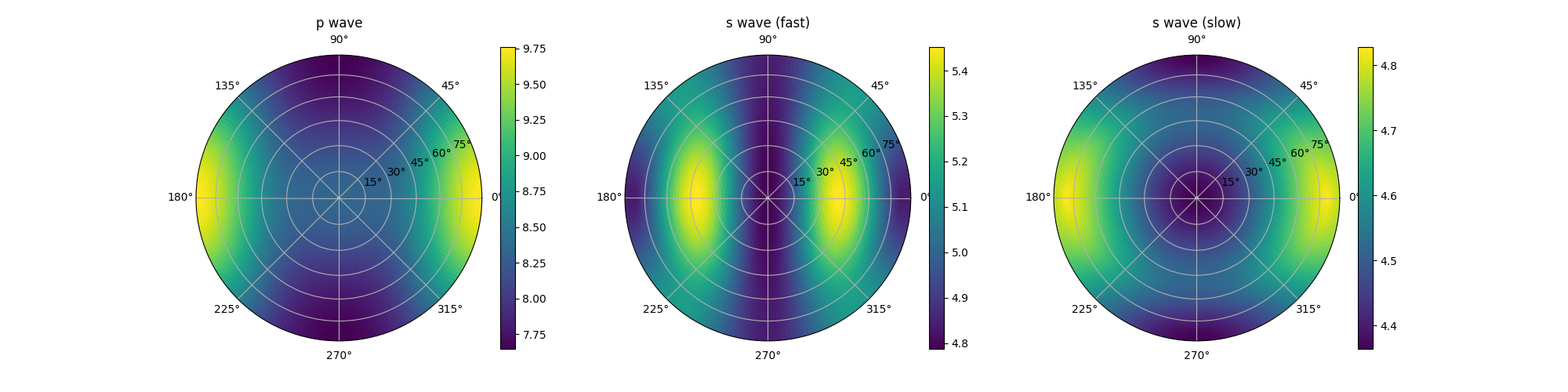
(<Figure size 2000x500 with 6 Axes>, <PolarAxes: title={'center': 's wave (slow)'}>)
Total running time of the script: (0 minutes 0.424 seconds)